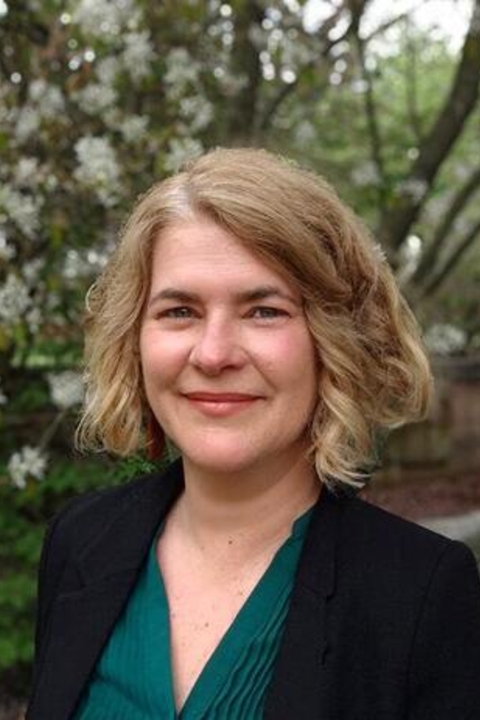
Leslie Gross-Wyrtzen is a Senior Lecturer in African Studies and Middle East Studies and faculty affiliate in Anthropology and ER&M. Her work focuses on the politics and economics of race, especially as they relate to mobility and place-making. Her first book, Bordering Blackness: Migration and Dispossession in the Afro-Mediterranean (Duke UP), is an ethnography of the EurAfrican border told through the experiences of African migrants as they travel through the Sahara Desert into Morocco and across the Mediterranean Sea. The book sheds light on and theorizes the racial and economic logics that stabilize this border regime across various geographies, actors, and interests and historicizes these logics in the longue durée of African captivity and racial othering.
This research was funded by the National Science Foundation, Fulbright-Hays, and the American Council of Learned Societies and has also appeared in The Journal of North African Studies, Environment and Planning D: Society and Space, ACME: A Journal of International Critical Geography, Geoforum, and Tumultes (Université Paris 7).
Currently, she is working on two projects:
Geography of Guns traces the history and afterlives of the gun manufacturing industry in colonial projects in the Mediterranean, Southern Africa, and the Caribbean as well as in urban spaces in New England’s “gun valley.” Partnering with community groups and using archival and ethnographic methods, the project explores the role that New England’s arms industry has had (and continues to have) in the production of urban and imperial spaces from the 19th century to the present and how ordinary people encounter these spaces in their movements, lives and bodies.
‘You’re not from Texas’: African Migrants in the US South (provisional title) is an ethnographic study of West and Central African migrants’ transatlantic trajectories from the EurAfrican borderlands to the American borderlands. Focused on south Texas, this study attends to migrants’ experiences in communities shaped by cross-border mobilities and intensifying immigration enforcement of long-resident populations. It looks at how unstable identities are challenged and transformed through various racialized, nationalist, and place-based discourses of belonging to forge new divisions and hierarchies as well as solidarities and senses of place.
Education
BA,MA, University of Texas at Austin
MA, PhD (Geography), Clark University
Courses offered (sampling)
- Introduction to Critical Border Studies
- Infrastructures of Empire
- What is the Global South? Africa in the World
- African Migration and Diasporas
- Comparative Settler Geographies
- Geography of Guns